Shipping Cost Pricing Strategy: How to Calculate and Charge Delivery Fees Profitably
The Hidden Margin Leak: How Delivery Costs Eat Online Shop Profits
One of the most common cash flow leaks in e-commerce stores is shipping and logistics. Many new merchants set a flat shipping rate (e.g., $3) based on competitor benchmarks, or offer unconditional free shipping to attract buyers and lower checkout friction.
However, once packaging weights increase, box dimensions expand, or buyers live in remote areas, actual courier costs can rise to double or triple your flat rate. If you subsidize this difference, it directly erodes your net profit. Learning to calculate shipping costs and apply strategic pricing models ensures your business maintains healthy contribution margins.
Popular E-commerce Shipping Fee Models
You can structure your storefront shipping charges in three primary ways depending on your brand strategy:
- Real-Time Carrier Rates: Dynamically calculates shipping charges at checkout based on total weight and dimensions, matching courier price lists. This eliminates shipping cost leaks but can increase shopping cart abandonment.
- Flat Rate Shipping: Charges a flat fee (e.g., $4) per order regardless of cart size. This encourages bulk buying to offset shipping, but requires calculating average shipping costs carefully.
- Free Shipping Thresholds: Offers free shipping once orders exceed a minimum value (e.g., "Free shipping on orders over $50"). This increases Average Order Value (AOV), provided your product pricing covers the average shipping subsidy.
The True Cost of Order Delivery
Shipping costs involve more than just courier charges. Calculate your total fulfillment cost using this formula:
For example, if the courier fee is $3, the cardboard box costs $0.50, bubble wrap costs $0.20, and tape/labels cost $0.10, your actual shipping cost is 3.00 + 0.50 + 0.20 + 0.10 = $3.80. If you charge a flat $3.00 shipping fee to the customer, you lose $0.80 on every order.
Using Gumrai to Optimize Shipping Costs
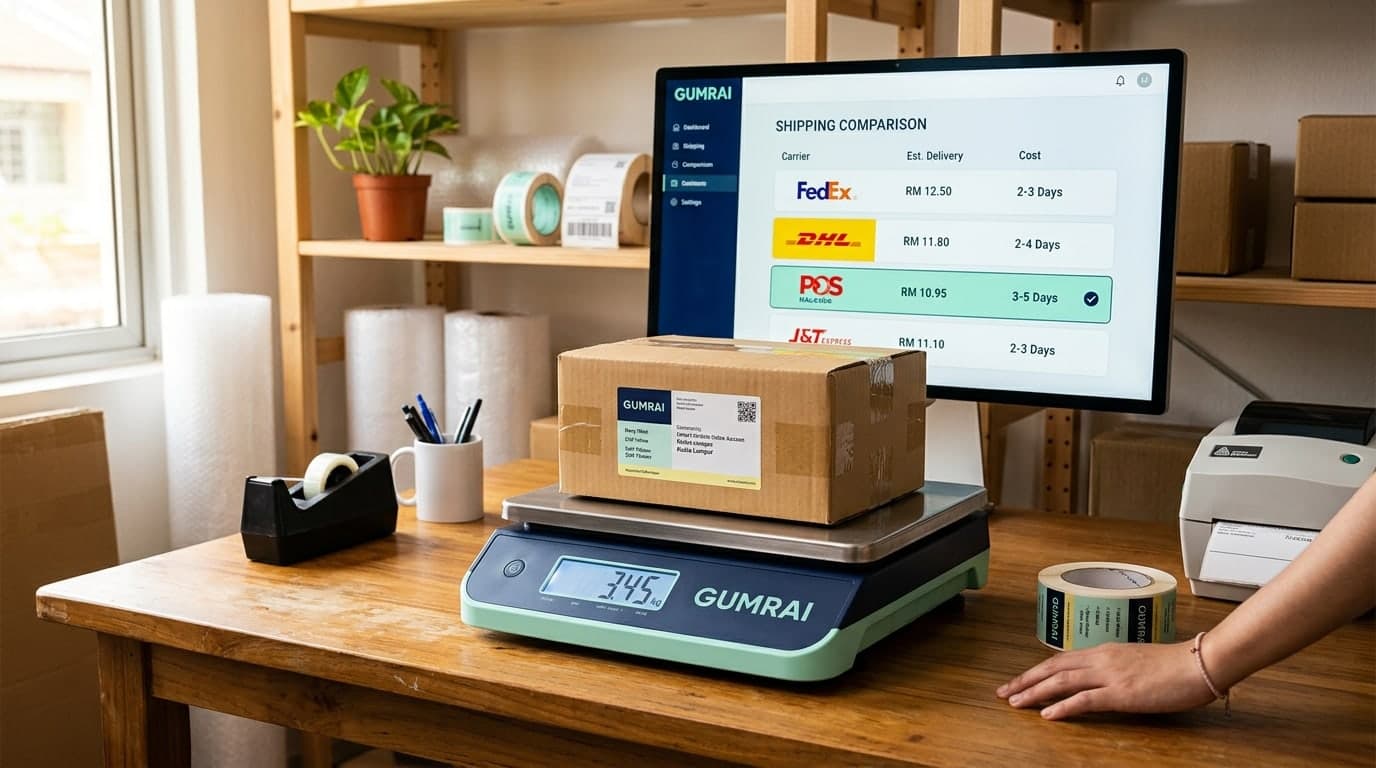
To identify the most cost-effective shipping carriers for your package sizes, use Gumrai's Shipping Cost Comparison Tool:
- Input your package dimensions (length, width, height) and weight.
- The tool calculates the dimensional weight volume and compares rates across major local shipping carriers instantly.
- Use this data to adjust your shipping fees or select smaller boxes to qualify for lower pricing brackets.
Real-World E-commerce Case Study
Scenario: A specialty food shop sold jars of sauce for $8 each (product cost $3, packaging $1). Charging a flat $3 shipping fee while actual packaging and courier costs totaled $4 meant a loss of $1 per order. By offering a "Set of 3 Jars for $24 with Free Shipping" bundle, they shipped all jars in a single box, reducing shipping overhead per unit and increasing their net profit per transaction.
Frequently Asked Questions (FAQ)
1. What is dimensional weight, and why is my shipping fee higher than expected?
Couriers charge based on dimensional weight for large, lightweight packages (like pillows or plush toys) to account for vehicle space. The formula is: (Length x Width x Height) ÷ 5000. If this value exceeds the physical weight, you are billed on volume.
2. How should I set my free shipping threshold?
Set your free shipping threshold 1.5x to 2x higher than your store's historical average order value to encourage customers to add more items to their carts.
3. Does box sizing affect transit damage?
Yes. Selecting smaller, snug-fitting boxes reduces the need for excessive bubble wrap, lowers shipping volume rates, and prevents products from sliding and sustaining damage in transit.
Summary: Protect Your Profits with Accurate Shipping Rates
Analyzing and setting accurate shipping fees is essential to protect your online margins. Choosing the right pricing model helps close sales while securing your bottom line.
Compare shipping rates today with Gumrai's Shipping Comparison Tool, verify unit profitability using the Profit Calculator, or optimize packaging with our Barcode Sticker Generator.
Want to set more accurate costs and selling prices?
Try Gumrai tools to calculate profit, set prices, and manage back-office tasks to make decisions faster.