
SECTION 01
Introduction: the same screen label can represent a different product
Beginners often see labels such as EURUSD, XAUUSD, US30, or BTCUSD and assume they are buying currency, gold, an index, or cryptocurrency itself. In practice, a platform symbol is only a label chosen by a provider. What you legally own—or what contract you have entered—can be completely different in ownership, settlement, and legal obligations.
Confusing the underlying asset with the instrument is a major source of error. Buying XAUUSD in MT5 does not automatically mean that you own bullion, and opening BTCUSD does not automatically provide the protections associated with a bank deposit or a conventional security.
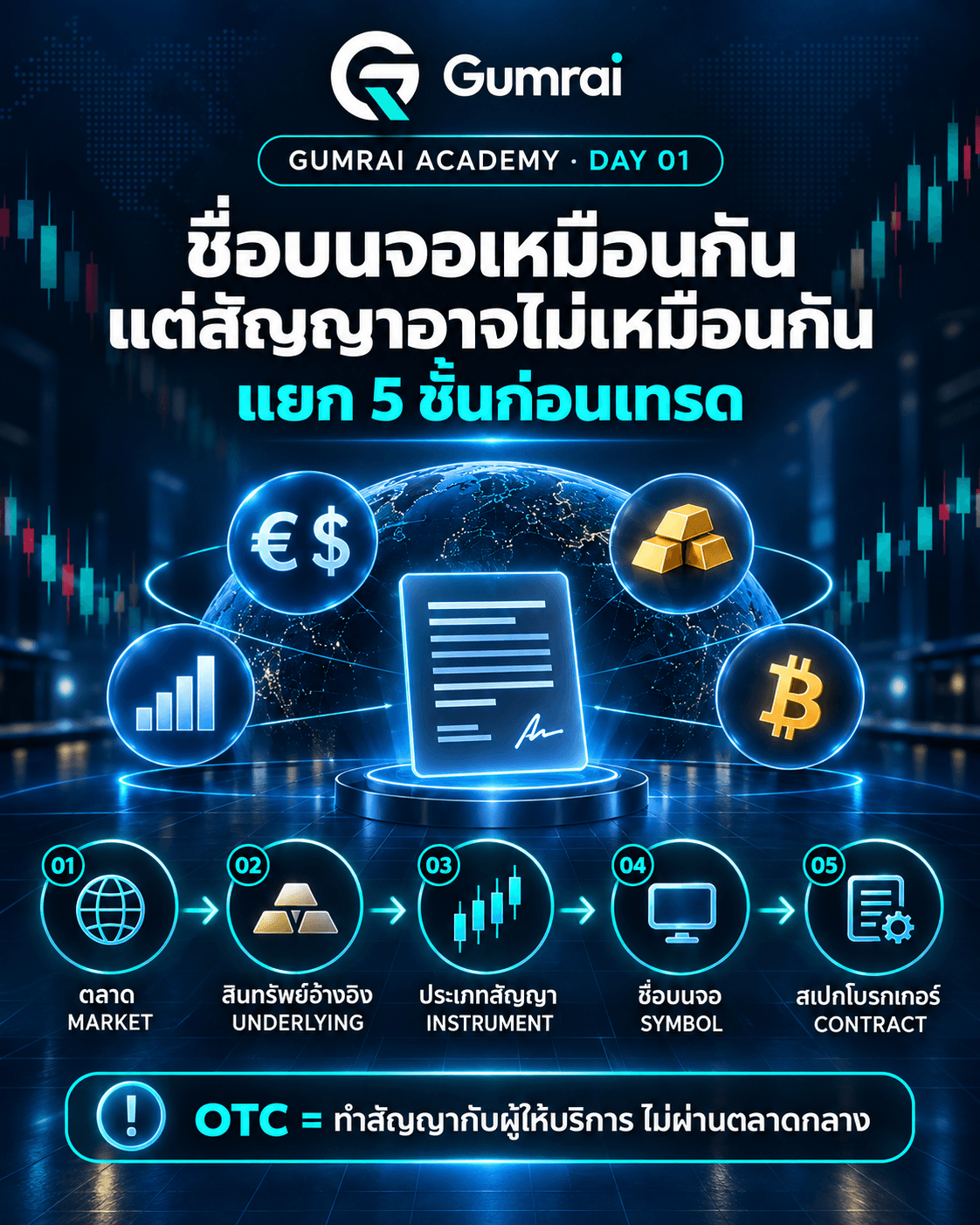
This lesson uses a five-layer model to look through the screen symbol, identify the real contract, and verify its Specification before any order is sent.
SECTION 02
The five-layer model: Market → Underlying → Instrument → Symbol → Broker Contract
Use these five connected layers whenever you analyse a financial product:
The venue or network from which the reference price and liquidity originate—for example, the OTC foreign-exchange market, COMEX/CME Group, a stock exchange, or a digital-asset exchange.
The currency, metal, index, security basket, or digital asset used as the economic reference—for example EUR/USD, a troy ounce of gold, the S&P 500, or Bitcoin.
The legal or financial form used to gain exposure to the underlying.
- Spot / physical: An agreement to buy and deliver the actual asset or currency.
- Futures: A standardized exchange-traded contract with an expiry date and either physical or cash settlement.
- CFD: An OTC contract between counterparties that settles the price difference without delivering the underlying asset.
- Index fund / ETF: A fund that owns a securities basket intended to track a reference index.
The screen label shown by a platform, such as EURUSD, XAUUSD, GC, 1OZ, US30, or BTCUSD. The same-looking label can represent different contracts at different providers.
The provider-specific rules attached to that symbol: contract size, tick size, tick value, margin and profit currencies, financing, execution method, and trading sessions. Verify these in MT5 Specification and the provider disclosure.
SECTION 03
Five major asset categories in detail
3.1 Foreign exchange (Forex)
- Underlying: the exchange rate between two currencies, such as EUR/USD or USD/JPY.
- Common instruments: OTC spot, outright forwards, FX swaps, FX options, FX futures, rolling spot FX, and FX CFDs.
- Market scale: the BIS April 2025 survey reported average global OTC FX turnover of $9.6 trillion per day. FX swaps represented 42%, spot 31%, outright forwards 19%, options 7%, and currency swaps 2%.
- Major currencies: the US dollar was on one side of 89.2% of trades, followed by the euro at 28.9%, yen 16.8%, sterling 10.2%, renminbi 8.5%, and Swiss franc 6.4%.
- Ownership: an FX CFD or other derivative normally provides price exposure rather than ownership of foreign banknotes or a foreign-currency deposit.
- Venue/provider: the OTC market. In the BIS survey, inter-dealer trading represented 46% and other financial institutions 50%; retail providers connect clients to this broader liquidity structure under their disclosed terms.
- Main risks: exchange-rate volatility, leverage, financing, execution, and counterparty risk.
- Verify: contract size, margin and profit currencies, swap type and rates, and the three-day financing day.
3.2 Contracts for difference (CFDs)
- Underlying: almost any referenced market, including indices, shares, metals, energy, FX, and crypto assets.
- Instrument: an OTC contract for differences.
- Ownership: none. A CFD exchanges the difference between opening and closing values; it does not transfer the referenced share, bullion, coin, or physical commodity.
- Venue/provider: an OTC provider that is the contractual counterparty under its disclosed execution model.
- Main risks: counterparty risk, leverage-amplified losses, financing charges, and provider-specific execution conditions.
- Verify: the product disclosure, Stops level, margin method, long/short swap, execution type, and trading sessions.
3.3 Gold
- Underlying: gold measured in troy ounces.
- Common instruments: physical gold, spot-gold CFDs, exchange-traded futures, and options.
- Gold Futures (GC): 100 troy ounces, physically deliverable through the COMEX delivery system, with a $0.10 per-ounce minimum price increment worth $10 per contract.
- Micro Gold Futures (MGC): 10 troy ounces and deliverable through an ACE representing a 10% interest in a 100-troy-ounce COMEX gold warrant.
- 1-Ounce Gold Futures (1OZ): one troy ounce, financially settled to the GC daily settlement price, with a $0.25 minimum increment worth $0.25 per contract.
- Spot Gold CFD (often labelled XAUUSD): an OTC, cash-settled contract referencing spot gold, generally without physical delivery.
- Ownership: GC and MGC can proceed to physical-delivery rights; 1OZ and a spot-gold CFD do not transfer bullion ownership.
- Venue/provider: COMEX/CME Globex for exchange products or an OTC provider for a CFD.
- Verify: physical versus financial settlement, contract size, tick size, tick value, expiry, and trading sessions.
3.4 Stock indices
- Underlying: a calculated basket such as the S&P 500, Dow Jones Industrial Average, or Russell 2000.
- Index funds and ETFs: funds holding securities to track an index, which may be market-cap weighted or price weighted.
- Index futures: exchange-traded contracts such as E-mini and Micro E-mini futures.
- Index CFDs: provider contracts labelled US30, SPX500, NAS100, or similar.
- Ownership: a futures or CFD position does not own the index constituents. An ETF investor owns fund shares rather than each underlying share directly.
- Main risks: tracking error and fees for funds; leverage and counterparty risk for derivatives.
- Verify: calculation method, contract size, tick size and value, and the applicable trading sessions.
3.5 Crypto assets
- Underlying: a blockchain or distributed-ledger asset such as Bitcoin or Ether.
- Common instruments: transferable spot crypto, futures, ETPs/ETFs, CFDs, and pairs trading.
- Legal protection: the SEC Division of Trading and Markets FAQ states that non-security crypto assets and unregistered crypto investment contracts are not SIPA securities and are not protected by SIPC.
- UCC Article 8: a provider may structure customer-account rights under Article 8, but that arrangement is separate from SIPC protection and conventional securities treatment.
- Ownership: transferable spot holdings may be withdrawn to a personal wallet. Crypto futures and CFDs provide contractual exposure without transferring the coin.
- Venue/provider: a crypto exchange, regulated securities or derivatives venue where applicable, or an OTC CFD provider.
- Main risks: extreme volatility, custody and technology risk, counterparty failure, leverage, and limited statutory protection.
- Verify: legal structure, custody and withdrawal rights, contract size, margin, swap, expiry, and risk disclosure.
SECTION 04
Comparison of the five asset categories
| Category | Underlying | Possible instrument | Own the asset? | Leverage possible? | Source of trading hours | What to verify |
|---|---|---|---|---|---|---|
| Forex | A currency-pair exchange rate | Spot, futures, forwards, swaps, options, CFD | Usually no for derivatives; possible for deliverable spot | Yes | Global OTC market or provider | Contract size, margin currency, profit currency, swap type and rates |
| CFD | Commodities, indices, shares, FX, or crypto | Contract for differences | No | Yes | Underlying market plus provider schedule | Stops level, margin method, swap rates, execution, PDS |
| Gold | Gold measured in troy ounces | Physical, GC/MGC/1OZ futures, options, CFD | Physical/GC/MGC can involve delivery; 1OZ and CFD do not | Yes | COMEX/CME Globex or OTC provider | Settlement type, contract size, tick size and tick value |
| Index | A calculated securities basket | Index fund/ETF, futures, CFD | Indirect through a fund; no for futures and CFD | Yes for futures and CFD | Stock exchange, futures exchange, or OTC provider | Calculation method, contract size, tick size, trading sessions |
| Crypto | A blockchain or DLT-based digital asset | Spot, futures, ETP/ETF, CFD, pairs trading | Yes for transferable spot holdings; no for futures and CFD | Yes | 24/7 crypto venue, derivatives exchange, or provider | Custody and SIPC status, contract size, margin, swap, expiry |
SECTION 05
Symbol case studies: EURUSD, XAUUSD, US30, and BTCUSD
EURUSDAnalysis: It may be a rolling spot FX CFD from an OTC provider or a price feed for another FX instrument.
What matters: The same label can represent different unit sizes and margin calculations. Confirm the instrument, contract size, margin method, and financing.
XAUUSDAnalysis: It commonly represents a cash-settled spot-gold CFD, although a provider can define a different contract under the same-looking label.
What matters: It is not automatically a COMEX GC, MGC, or 1OZ contract and does not provide COMEX delivery rights.
US30Analysis: It is a provider label referencing the Dow Jones Industrial Average.
What matters: There is no universal US30 contract. Contract size, tick size, tick value, and trading sessions can differ between providers.
BTCUSDAnalysis: It can be a transferable spot pair, a crypto CFD, or another derivative feed.
What matters: A BTCUSD CFD does not transfer Bitcoin to a wallet. Verify ownership, custody, financing, margin, and legal protections.
SECTION 06
MT5 Specification checklist: 10 items to inspect before ordering
In MetaTrader 5, open Market Watch, select the symbol, and open Specification. Check these provider-defined parameters:
- 1
Contract Size
The number of underlying units represented by one lot. A standard FX lot may be 100,000 units, while metals and indices use provider-specific values.
- 2
Tick Size
The smallest permitted price movement, such as 0.01 or 0.001.
- 3
Tick Value
The profit or loss, in the stated profit currency, when one lot moves by one tick size.
- 4
Minimum Volume
The smallest order volume the system accepts, such as 0.01 lot.
- 5
Volume Step
The increment by which order volume can be raised or reduced.
- 6
Margin Parameters
The calculation method and any initial, maintenance, or hedged-margin requirements.
- 7
Swap / Financing
The financing method, long and short rates, and the day on which a three-day charge may be applied.
- 8
Trading Sessions
The quoting and trading schedule for each day of the week, including maintenance breaks.
- 9
Stops Level
The minimum distance, in points, allowed between the current price and a stop-loss, take-profit, or pending order. Orders inside this distance may return “Invalid Stops.”
- 10
Profit Currency & Margin Currency
The currencies used to calculate profit/loss and the required margin.
SECTION 07
Never guess these four things when trading
- Ownership: seeing an asset name on screen does not mean you own the asset. Confirm whether the instrument is spot, futures, a CFD, or something else.
- Point or tick value: US30 or XAUUSD can use different contract sizes and monetary values at different providers. Guessing can create a position far larger than intended.
- Sessions, rollover, and settlement: products have different maintenance windows, expiries, financing dates, and three-day swap rules.
- Leverage and margin: requirements vary by provider, account, and asset category. Check the actual margin calculation before opening a position.
SECTION 08
Classification exercise: five symbols
For every item, begin by opening the relevant Specification or product disclosure. Do not answer from the symbol alone.
1Item 1: EURUSD in an MT5 accountView answerHide answer
Answer: Open MT5 Specification and the provider disclosure first. Confirm whether it is rolling spot FX/CFD or another instrument. If it is an OTC FX CFD, you do not own euro banknotes; check contract size, margin method, and overnight financing.2Item 2: XAUUSD with an OTC providerView answerHide answer
Answer: Open Specification and the product disclosure first. XAUUSD is commonly a cash-settled spot-gold CFD, not direct ownership of bullion and not a COMEX GC, MGC, or 1OZ contract. Check contract size, tick size, tick value, and stops level.3Item 3: US30View answerHide answer
Answer: Open Specification first. US30 is a provider label referring to the Dow Jones Industrial Average, not one universal contract. Contract size, tick value, and trading hours can differ materially between providers.4Item 4: BTCUSDView answerHide answer
Answer: Confirm whether the product is transferable spot crypto or a crypto CFD. A crypto CFD does not transfer Bitcoin to your wallet. Check contract size, margin, overnight financing, expiry, custody terms, and legal protections.5Item 5: 1OZView answerHide answer
Answer: Use the CME contract documents. CME 1-Ounce Gold Futures represent one troy ounce, have a $0.25 minimum price increment worth $0.25 per contract, and are financially settled rather than physically delivered.
SECTION 09
Three-question knowledge check with explanations
Questions
Question 1 — Instrument and structure
Under the standard CME Group contract terms, what does a holder of Micro Gold Futures (MGC) receive if the contract proceeds to delivery?
- A. Cash settlement only
- B. Physical delivery through an ACE (Accumulated Certificate of Exchange)
- C. Automatic conversion to a spot-gold CFD
- D. Cancellation without settlement
Open answer and explanationHide answer
Explanation: MGC is deliverable through an ACE representing a 10% ownership interest in a 100-troy-ounce COMEX gold warrant. This differs from the 1OZ contract, which is financially settled.
Question 2 — Ownership and protection
According to the SEC Division of Trading and Markets FAQ, does SIPC protect a non-security crypto asset held through a broker if that broker fails?
- A. Yes, in the same way as stocks and bonds
- B. Only the profit is protected
- C. No, because SIPA protection applies to securities as defined by the statute
- D. Only Bitcoin is protected
Open answer and explanationHide answer
Explanation: The SEC FAQ explains that non-security crypto assets are not “securities” for SIPA purposes and therefore are not protected by SIPC. Customer-account treatment under UCC Article 8 is a separate issue and does not turn the asset into a SIPA-protected security.
Question 3 — MT5 Specification
If MT5 Specification shows a Stops level of 50, what does it mean?
- A. Every order costs $50
- B. Stop-loss, take-profit, and pending orders cannot be placed fewer than 50 points from the current price
- C. The broker closes the account at a 50% loss
- D. The symbol allows a maximum of 50 lots
Open answer and explanationHide answer
Explanation: MetaTrader 5 defines Stops level as the minimum distance, in points, from the current close price at which stop and pending orders can be placed. An order inside that distance can be rejected as “Invalid Stops.”
SECTION 10
Five key takeaways
- 1A screen symbol is not the asset itself. The actual position depends on the instrument and the provider contract.
- 2Use the five layers: Market → Underlying → Instrument → Symbol → Broker Contract.
- 3A CFD does not transfer ownership of the underlying share, bullion, currency, or crypto asset.
- 4Legal and insolvency protections differ between exchange products, securities, OTC CFDs, and non-security crypto assets.
- 5Always verify contract size, tick value, margin, financing, settlement, and trading sessions in Specification or the product disclosure.
SECTION 11
Risk warning
Financial contracts, derivatives, and CFDs involve substantial risk, particularly when leverage is used, and losses can exceed the amount you expected to risk. Products differ in legal structure, obligations, settlement, and provider exposure. Read the contract Specification and product disclosure carefully before making any trading decision.
SECTION 12
References
- 1CME Group. “Gold Futures — GC, MGC and 1OZ product comparison.”
- 2CME Group. “FAQ: 1-Ounce Gold Futures.”
- 3CME Group. “Gold Futures and Options Contract Specifications.”
- 4CME Group. “Gold Futures and Options Fact Card — Micro Gold contract and ACE delivery.”
- 5U.S. Commodity Futures Trading Commission. “Eight Things You Should Know Before Trading Forex.”
- 6U.S. Securities and Exchange Commission. “Frequently Asked Questions Relating to Crypto Asset Activities and Distributed Ledger Technology.” Updated February 19, 2026.
- 7SEC / Investor.gov. “Contracts for Difference (CFDs).”
- 8SEC / Investor.gov. “Index Funds.”
- 9MetaQuotes. “Market Watch — Trading Operations — MetaTrader 5 Help.”
- 10Bank for International Settlements. “OTC foreign exchange turnover in April 2025 — Triennial Central Bank Survey.” Published September 30, 2025.